Control Plane Architecture
The Control Plane is the management layer of the Dataspace Ecosystem, responsible for handling contracts, policies, assets, and catalog operations.
Overview
graph TB
    CA[Consumer App]

    subgraph ConsumerEcosystem[Consumer]
        CCP[Consumer Control Plane]
        CIH[Consumer Identity Hub]
        CDB[(Database)]
    end

    subgraph ProviderEcosystem[Provider]
        PCP[Provider Control Plane]
        PIH[Provider Identity Hub]
        PDB[(Database)]
    end

    subgraph Authority[Dataspace Authority]
        FCF[Federated Catalog Filter]
        FC[Federated Catalog]
        AuthIH[Authority Identity Hub]
    end

    subgraph VCIssuers[VC Issuers]
        DID[DID Document]
    end

    CA --> CCP
    CCP --> PCP
    CCP --> FCF
    PCP --> FCF
    FCF --> FC
    PCP --> CIH
    PCP --> DID
    CCP --> CDB
PCP --> PDBComponents
Management API
RESTful API for managing all control plane resources:
- /v3/assets - Asset management
- /v3/policies - Policy definitions
- /v3/contractdefinitions - Contract definitions
- /v3/contractnegotiations - Contract negotiations
- /v3/catalog - Catalog operations
Asset Service
Manages data assets within the dataspace. See Asset API documentation for detailed endpoint information.
Policy Service
Defines and evaluates usage policies using ODRL. See Policy Definitions API documentation for detailed endpoint information.
Contract Definition Service
Links assets with policies to create offerings. See Contract Definitions API documentation for detailed endpoint information.
Contract Negotiation Service
Handles the negotiation protocol between participants. See Contract Negotiations API documentation for detailed endpoint information.
Contract Negotiation Flow
The following diagram illustrates the contract negotiation process between a consumer and provider:
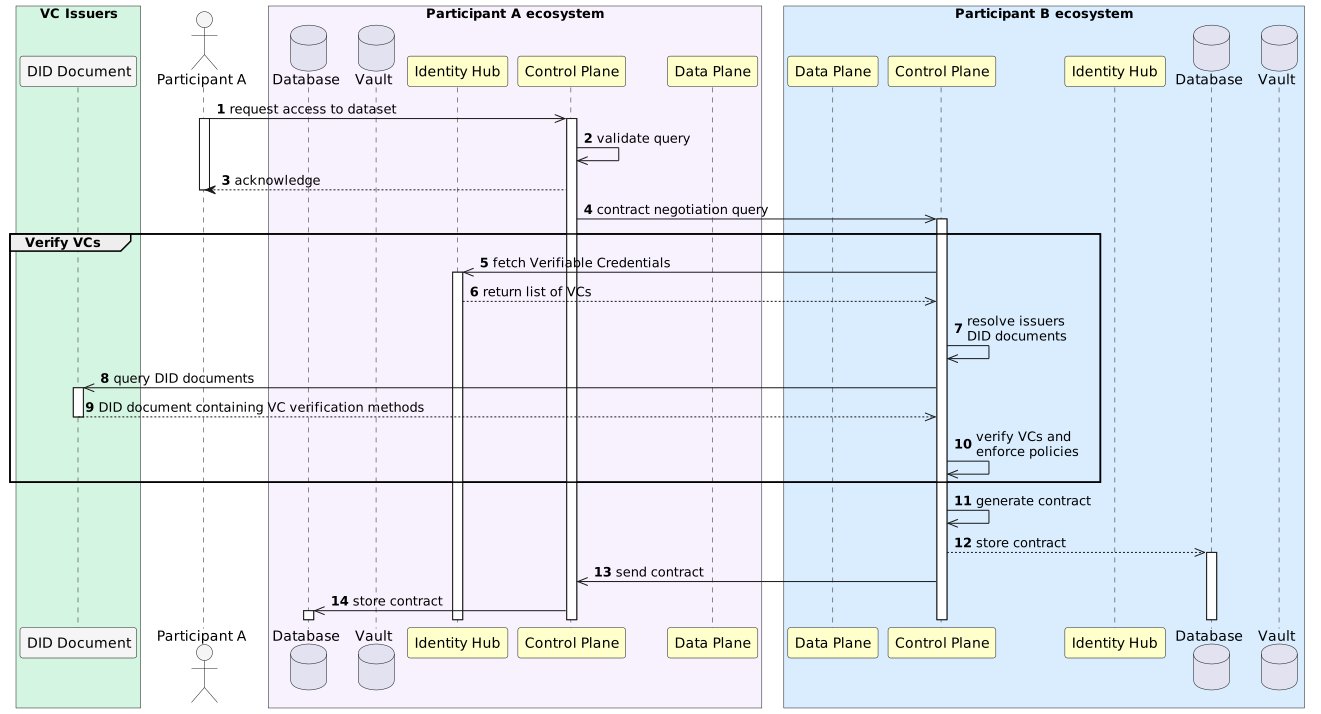
State Machine of the contract negotiation
The contract negotiation follows an automated state machine protocol between control planes:
stateDiagram-v2
    [*] --> INITIAL
    INITIAL --> REQUESTING: Consumer requests
    REQUESTING --> OFFERED: Provider offers
    OFFERED --> ACCEPTING: Consumer accepts
    ACCEPTING --> AGREED: Provider confirms
    AGREED --> VERIFIED: Both sides verify
    VERIFIED --> FINALIZED: Contract active
    REQUESTING --> TERMINATED: Rejection
    OFFERED --> TERMINATED: Rejection
ACCEPTING --> TERMINATED: RejectionNote: This entire negotiation process is automated and handled by the control planes using the IDS protocol. The "Consumer requests", "Provider offers", etc. represent protocol messages exchanged automatically between the systems, not manual user actions. Once a consumer application initiates a data request, the control planes handle the entire negotiation flow automatically based on predefined policies and contract definitions.
Configuration
Control Plane configuration can be provided through multiple methods:
Application Properties File
Create application.properties in your launcher's resources:
# Control Plane Configuration
edc.hostname=localhost
web.http.port=8181
web.http.path=/api
web.http.management.port=8182
web.http.management.path=/management
web.http.protocol.port=8282
web.http.protocol.path=/protocol
Environment Variables
Set configuration via environment variables (prefix with EDC_):
export EDC_HOSTNAME=localhost
export EDC_WEB_HTTP_PORT=8181
export EDC_WEB_HTTP_PATH=/api
export EDC_WEB_HTTP_MANAGEMENT_PORT=8182
export EDC_WEB_HTTP_MANAGEMENT_PATH=/management
export EDC_WEB_HTTP_PROTOCOL_PORT=8282
export EDC_WEB_HTTP_PROTOCOL_PATH=/protocol
Launcher Configuration
In launcher build configurations (e.g., launchers/control-plane/postgresql-hashicorpvault/):
// Via @Setting annotations in extension classes
@Setting(description = "Control plane hostname", key = "edc.hostname", defaultValue = "localhost")
private String hostname;
Docker/Kubernetes
For containerized deployments, use environment variables in your deployment manifests:
apiVersion: apps/v1
kind: Deployment
spec:
  template:
    spec:
      containers:
      - name: control-plane
        env:
        - name: EDC_HOSTNAME
          value: "my-control-plane.example.com"
        - name: EDC_WEB_HTTP_PORT
          value: "8181"
Extension Points
Policy Evaluation Functions
Register custom policy constraint functions for different scopes (based on PolicyEvaluationExtension):
public class PolicyEvaluationExtension implements ServiceExtension {

    @Inject
    private PolicyEngine policyEngine;

    @Inject
    private RuleBindingRegistry ruleBindingRegistry;

    @Override
    public void initialize(ServiceExtensionContext context) {
        // Register functions for different policy contexts
        policyEngine.registerFunction(
            CatalogPolicyContext.class,
            Permission.class,
            new MembershipConstraintFunction<>()
        );
        policyEngine.registerFunction(
            ContractNegotiationPolicyContext.class,
            Permission.class,
            new MembershipConstraintFunction<>()
        );
        policyEngine.registerFunction(
            TransferProcessPolicyContext.class,
            Permission.class,
            new MembershipConstraintFunction<>()
        );
    }
}
Policy Scopes
| Scope | Context Class | Description |
|---|---|---|
catalog | CatalogPolicyContext | Catalog access policies |
contract.negotiation | ContractNegotiationPolicyContext | Contract negotiation policies |
transfer.process | TransferProcessPolicyContext | Transfer process policies |
catalog.discovery | CatalogDiscoveryPolicyContext | Federated catalog discovery |
See Also
- Control Plane API Reference — To see the REST endpoints exposed by this component, including request/response examples for assets, policies, contracts, catalog queries, and transfers
- Data Plane Architecture — The component that handles actual data transfer after contracts are negotiated here
- Identity Hub Architecture — Provides the credential verification used during contract negotiation
- API Reference Overview — End-to-end API workflow showing how the Control Plane fits into the full data exchange flow