Infrastructure Model v2
The Infrastructure Model v2 is the next generation of Yggy's network topology model. It replaces the fixed four-level hierarchy of v1 (Target → Landingzone → ZoneInstance → SubnetInstance) with a single, recursive building block: the Perimeter.
Combined with first-class network feature objects (NextHop, Peering), v2 enables teams to model arbitrary network topologies — from simple flat networks to complex hub-and-spoke architectures — without being constrained by a rigid structure.
Design, not shipped code
None of this model is implemented in this release. Perimeter, NextHop and Peering do not exist in the published codebase; the code in aud/ implements Infrastructure Model v1 only. This page is published as design documentation so the direction is public and reviewable — read it as a specification, not as an API you can call today.
Tip
If you're familiar with Infrastructure Model v1, the Key Differences section below maps v1 concepts to their v2 equivalents.
Key Differences from v1
| Aspect | v1 | v2 |
|---|---|---|
| Structure | Fixed 4-level hierarchy (Target → Landingzone → ZoneInstance → SubnetInstance) | Recursive Perimeter tree (unlimited depth) |
| Object types | 4 distinct types with different schemas | 1 core type (Perimeter) composable at any level |
| Network features | Implicit (derived from zone types and firewall groups) | Explicit first-class objects (NextHop, Peering) |
| CIDRs | Only on SubnetInstance | On any Perimeter (leaf or intermediate) |
| Extensibility | None — fixed schema | Dynamic extensions via Schema registry |
| API version | api_version: v1 | apiVersion: v2 |
| Identity | scope + name | domain + name |
Excalidraw Source
Perimeter
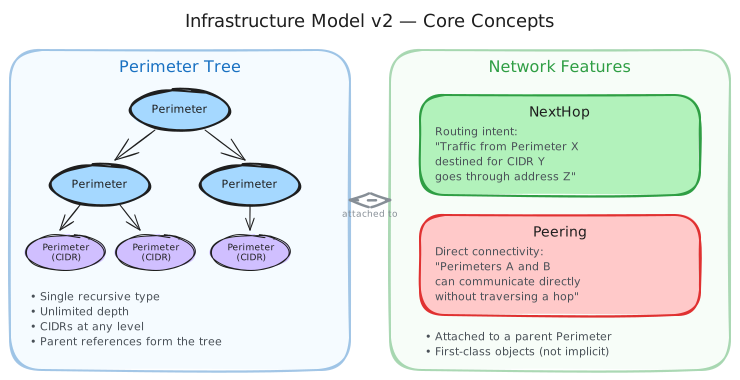
A Perimeter is the fundamental building block of the v2 infrastructure model. It represents a network boundary at any level of abstraction — from an entire cloud region down to a single isolation zone.
Perimeters form a tree through parent references. A perimeter with no parent is a root (e.g., a target-level grouping). A perimeter with a parent is a child that inherits the network context of its ancestor.
Key Attributes
| Attribute | Description |
|---|---|
metadata.name | Unique name within the domain |
metadata.domain | Ownership domain (replaces v1's scope) |
metadata.labels | Key-value pairs for selection and filtering |
spec.cidrs | Optional list of CIDR blocks owned by this perimeter |
spec.parent | Optional reference to a parent perimeter (name + domain) |
How It Maps to v1
| v1 Concept | v2 Equivalent |
|---|---|
| Target | Root Perimeter (no parent) |
| Landingzone | Child Perimeter of a Target-level perimeter |
| ZoneInstance | Child Perimeter of a Landingzone-level perimeter |
| SubnetInstance | Leaf Perimeter with CIDRs |
YAML Examples
# Root perimeter (equivalent to a v1 Target)
---
apiVersion: v2
kind: Perimeter
metadata:
  name: test-west-europe
  domain: Network
spec:
  cidrs:
    - 172.16.0.0/16

# Spoke perimeter (equivalent to a v1 Landingzone)
---
apiVersion: v2
kind: Perimeter
metadata:
  name: spoke-integration-01
  domain: Network
spec:
  parent:
    name: test-west-europe
    domain: Network

# Hub perimeter
---
apiVersion: v2
kind: Perimeter
metadata:
  name: hub-west-europe
  domain: Network
spec:
  parent:
    name: test-west-europe
    domain: Network

# Isolation zone (equivalent to a v1 ZoneInstance)
---
apiVersion: v2
kind: Perimeter
metadata:
  name: app-zone-1
  domain: Network
spec:
  parent:
    name: spoke-integration-01
    domain: Network

# Leaf perimeter with CIDRs (equivalent to a v1 SubnetInstance)
---
apiVersion: v2
kind: Perimeter
metadata:
  name: app-zone-1-subnet-a
  domain: Network
spec:
  cidrs:
    - 172.16.10.0/24
  parent:
    name: app-zone-1
    domain: Network
Tree Structure
Perimeters form a tree that can be queried at any level:
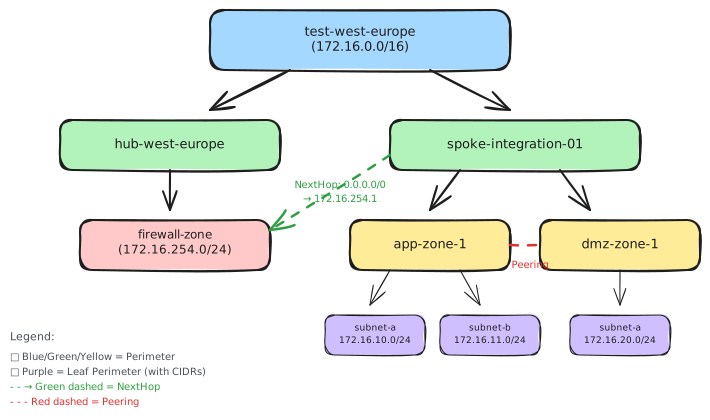
test-west-europe (172.16.0.0/16)
├── hub-west-europe
│   └── firewall-zone (172.16.254.0/24)
└── spoke-integration-01
    ├── app-zone-1
    │   ├── app-zone-1-subnet-a (172.16.10.0/24)
    │   └── app-zone-1-subnet-b (172.16.11.0/24)
    └── dmz-zone-1
        └── dmz-zone-1-subnet-a (172.16.20.0/24)
NextHop
A NextHop declares routing intent for a perimeter: "all traffic from this perimeter destined for a given CIDR should go through a specific next-hop address."
This is how you model firewall routing — traffic from a spoke is routed through a firewall appliance in the hub before reaching its destination.
Key Attributes
| Attribute | Description |
|---|---|
metadata.name | Identifier for this routing declaration |
metadata.domain | Ownership domain |
spec.parent | The perimeter whose traffic is being routed |
spec.nextHops | List of routing entries, each with: |
spec.nextHops[].destination | Destination CIDR (e.g., 0.0.0.0/0 for default route) |
spec.nextHops[].address.ip | IP address of the next hop (e.g., firewall IP) |
spec.nextHops[].address.perimeter | The perimeter where the next hop resides |
YAML Example
# All traffic from spoke-integration-01 routes through the firewall
---
apiVersion: v2
kind: NextHop
metadata:
  name: spoke-integration-01-default-route
  domain: Network
spec:
  parent:
    name: spoke-integration-01
    domain: Network
  nextHops:
    - destination: 0.0.0.0/0
      address:
        ip: 172.16.254.1
        perimeter:
          name: firewall-zone
          domain: Network
This declares that any traffic leaving spoke-integration-01 with no more specific route should be forwarded to 172.16.254.1 (a firewall in firewall-zone).
Multiple Next Hops
A perimeter can have multiple next-hop entries for different destinations:
---
apiVersion: v2
kind: NextHop
metadata:
  name: spoke-integration-01-routes
  domain: Network
spec:
  parent:
    name: spoke-integration-01
    domain: Network
  nextHops:
    - destination: 0.0.0.0/0
      address:
        ip: 172.16.254.1
        perimeter:
          name: firewall-zone
          domain: Network
    - destination: 10.0.0.0/8
      address:
        ip: 172.16.254.2
        perimeter:
          name: firewall-zone
          domain: Network
Peering
A Peering declares which perimeters can directly communicate with each other within the same parent context. Without a peering declaration, perimeters are isolated — traffic between them must go through a next hop (e.g., a firewall).
Key Attributes
| Attribute | Description |
|---|---|
metadata.name | Identifier for this peering declaration |
metadata.domain | Ownership domain |
spec.parent | The parent perimeter context for this peering |
spec.peers | List of perimeters that can communicate directly |
YAML Example
# Allow direct communication between app-zone-1 and dmz-zone-1
---
apiVersion: v2
kind: Peering
metadata:
  name: spoke-integration-01-peering
  domain: Network
spec:
  parent:
    name: spoke-integration-01
    domain: Network
  peers:
    - name: app-zone-1
      domain: Network
    - name: dmz-zone-1
      domain: Network
This declares that app-zone-1 and dmz-zone-1 within spoke-integration-01 can exchange traffic directly without traversing the hub firewall.
Peering vs NextHop
- Peering = direct lateral connectivity between sibling perimeters (no intermediary).
- NextHop = traffic must transit through a specific address (typically a firewall or router).
If two perimeters are neither peered nor share a next-hop path, they are isolated from each other.
Extensibility
The v2 model supports dynamic schema extensions that let teams create specialized perimeter types without modifying the core model. Extensions inherit from a base kind and add domain-specific attributes.
For example, an IsolationZone extension of Perimeter can add an isolationLevel attribute:
---
apiVersion: v2
kind: Schema
metadata:
  name: IsolationZone
  extends: Perimeter
spec:
  schema:
    type: object
    properties:
      spec:
        type: object
        properties:
          isolationLevel:
            type: string
Once registered, instances of IsolationZone are created and queried like any perimeter, but carry additional metadata:
---
apiVersion: v2
kind: IsolationZone
metadata:
  name: app-zone-1
  domain: Network
spec:
  isolationLevel: HIGH
  parent:
    name: spoke-integration-01
    domain: Network
Extensions are fully compatible with the base type — an IsolationZone appears in perimeter tree queries and can be referenced as a parent or peer like any other perimeter.
End-to-End Example
Here is a complete scenario modeling a hub-and-spoke network topology with firewall routing:
Scenario: A test environment in West Europe with:
- A hub containing a firewall zone
- A spoke containing two isolation zones (app and dmz)
- Default routing through the firewall
- Direct peering between app and dmz zones within the spoke
# =============================================================
# ROOT: Target-level perimeter
# =============================================================
---
apiVersion: v2
kind: Perimeter
metadata:
  name: test-west-europe
  domain: Network
spec:
  cidrs:
    - 172.16.0.0/16

# =============================================================
# HUB: Hub perimeter with firewall
# =============================================================
---
apiVersion: v2
kind: Perimeter
metadata:
  name: hub-west-europe
  domain: Network
spec:
  parent:
    name: test-west-europe
    domain: Network
---
apiVersion: v2
kind: Perimeter
metadata:
  name: firewall-zone
  domain: Network
spec:
  cidrs:
    - 172.16.254.0/24
  parent:
    name: hub-west-europe
    domain: Network

# =============================================================
# SPOKE: Spoke perimeter with isolation zones
# =============================================================
---
apiVersion: v2
kind: Perimeter
metadata:
  name: spoke-integration-01
  domain: Network
spec:
  parent:
    name: test-west-europe
    domain: Network

# --- App zone with leaf perimeters ---
---
apiVersion: v2
kind: Perimeter
metadata:
  name: app-zone-1
  domain: Network
spec:
  parent:
    name: spoke-integration-01
    domain: Network
---
apiVersion: v2
kind: Perimeter
metadata:
  name: app-zone-1-subnet-a
  domain: Network
spec:
  cidrs:
    - 172.16.10.0/24
  parent:
    name: app-zone-1
    domain: Network
---
apiVersion: v2
kind: Perimeter
metadata:
  name: app-zone-1-subnet-b
  domain: Network
spec:
  cidrs:
    - 172.16.11.0/24
  parent:
    name: app-zone-1
    domain: Network

# --- DMZ zone with leaf perimeter ---
---
apiVersion: v2
kind: Perimeter
metadata:
  name: dmz-zone-1
  domain: Network
spec:
  parent:
    name: spoke-integration-01
    domain: Network
---
apiVersion: v2
kind: Perimeter
metadata:
  name: dmz-zone-1-subnet-a
  domain: Network
spec:
  cidrs:
    - 172.16.20.0/24
  parent:
    name: dmz-zone-1
    domain: Network

# =============================================================
# NETWORK FEATURES
# =============================================================

# Default route: spoke traffic goes through firewall
---
apiVersion: v2
kind: NextHop
metadata:
  name: spoke-integration-01-default-route
  domain: Network
spec:
  parent:
    name: spoke-integration-01
    domain: Network
  nextHops:
    - destination: 0.0.0.0/0
      address:
        ip: 172.16.254.1
        perimeter:
          name: firewall-zone
          domain: Network

# Direct peering: app and dmz zones can talk directly
---
apiVersion: v2
kind: Peering
metadata:
  name: spoke-integration-01-internal-peering
  domain: Network
spec:
  parent:
    name: spoke-integration-01
    domain: Network
  peers:
    - name: app-zone-1
      domain: Network
    - name: dmz-zone-1
      domain: Network
Resulting Topology
test-west-europe (172.16.0.0/16)
│
├── hub-west-europe
│   └── firewall-zone (172.16.254.0/24)
│         ↑
│         │ NextHop: 0.0.0.0/0 → 172.16.254.1
│         │
└── spoke-integration-01
    │
    ├── app-zone-1 ←─── Peering ───→ dmz-zone-1
    │   ├── app-zone-1-subnet-a (172.16.10.0/24)
    │   └── app-zone-1-subnet-b (172.16.11.0/24)
    │
    └── dmz-zone-1
        └── dmz-zone-1-subnet-a (172.16.20.0/24)
Traffic flow:
- Traffic between
app-zone-1anddmz-zone-1flows directly (peered). - Traffic from
spoke-integration-01to any other destination routes through 172.16.254.1 (firewall in the hub). - Traffic within a single perimeter (e.g., between
app-zone-1-subnet-aandapp-zone-1-subnet-b) flows freely — they share the same parent.
Detailed Topology Diagram