Infrastructure Model v1
This page describes the core infrastructure objects that form the physical and logical network topology in Yggy. These objects are organized in a strict hierarchy, from broad geographic/phase groupings down to individual network subnets.
Tip
If you're new to Yggy, read Core Concepts first to understand descriptors and how the model fits into the bigger picture.
Hierarchy Overview
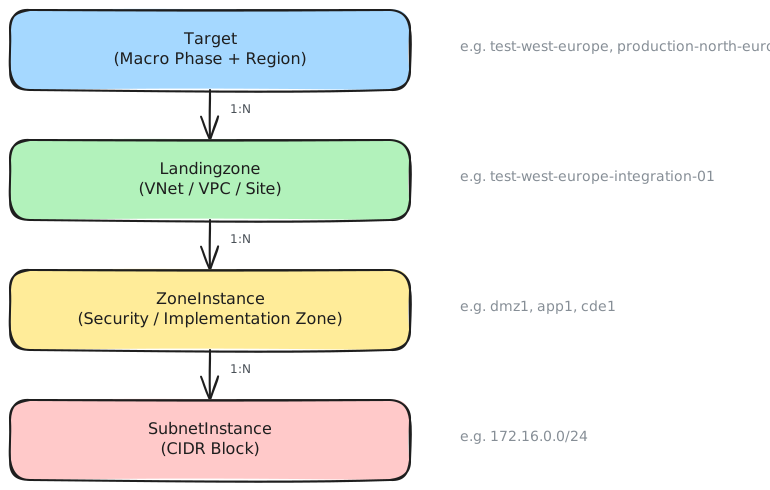
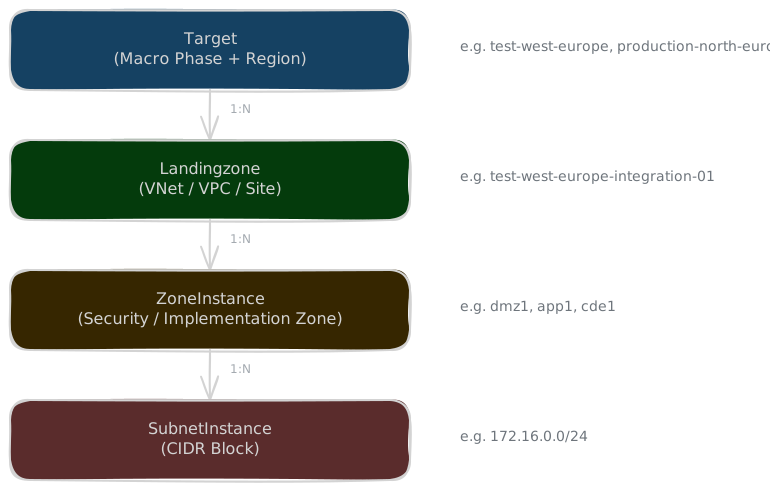
The infrastructure model follows a top-down hierarchy:
Excalidraw Source
Each level refines the scope of the network environment:
| Level | Object | Purpose |
|---|---|---|
| 1 | Target | Groups landing zones by macro phase + region |
| 2 | Landingzone | A network environment (VNet, VPC, legacy site) |
| 3 | ZoneInstance | A security/implementation zone within a landing zone |
| 4 | SubnetInstance | A specific CIDR block within a zone instance |
Target
A Target is the highest-level grouping in the infrastructure model. It represents the combination of a Macro Phase (e.g., RND, TST, PRD) and a Region (e.g., West Europe, North Europe), along with metadata about the cloud provider and continent.
All Landing Zones and hubs belonging to the same macro phase and region are grouped under a single Target.
Key Attributes
| Attribute | Description |
|---|---|
name | Identifier for the target (e.g., test-west-europe, production-north-europe) |
macro_phase | The lifecycle phase: RND, TST, PRD, etc. |
continent | Geographic continent (e.g., Europe, Worldwide) |
provider | Cloud provider or On Premise identifier (e.g., Microsoft - Azure, Amazon - AWS) |
target_type | Classification: Regional Hub, Lite Hub, Legacy |
Examples
| Name | Macro Phase | Provider | Target Type |
|---|---|---|---|
test-west-europe | TST | Microsoft - Azure | Regional Hub |
production-north-europe | PRD | Microsoft - Azure | Regional Hub |
Landingzone
A Landingzone is a network environment that belongs to a Target. In Azure, it typically corresponds to a Virtual Network (VNet); in AWS, to a VPC; in legacy environments, to a physical site.
A landing zone groups all the zone instances and subnets that exist within that network boundary.
Key Attributes
| Attribute | Description |
|---|---|
name | Unique identifier (e.g., test-west-europe-integration-01) |
target | The parent Target this landing zone belongs to |
region | Provider region (e.g., West Europe, North Europe) |
macro_phase | Lifecycle phase (inherited from target) |
landing_zone_type | Type classification (see below) |
functional_types | Optional functional labels for automatic instantiation |
Landing Zone Types
| Type | Description |
|---|---|
| Default Azure Spoke | Standard Azure spoke VNet |
| Amazon HUB | AWS hub network |
| Legacy | On-premises |
ZoneInstance
A ZoneInstance represents an implementation zone within a landing zone. It defines a security boundary where specific Network security layer rules and firewall policies apply.
Each zone instance is associated with a zone type that determines the security classification (e.g., DMZ, application, transit).
Key Attributes
| Attribute | Description |
|---|---|
name | Identifier within the landing zone (e.g., dmz1, app1, cde1) |
landing_zone | The parent landing zone |
zone_type | Security zone classification (see below) |
Zone Types
| Zone Type | Description |
|---|---|
dmz | Demilitarized zone — public-facing services |
app | Application zone — internal application workloads |
cde | Cardholder Data Environment — PCI-compliant zone |
Usage with Component Instances (Applicative Intent)
IaaS-hosted Component Instances
For IaaS component instances (virtual machines, bare-metal servers), the component instance declares its location using in_zone_instance and out_zone_instance, which point to specific zone instances. The security zone is determined implicitly from the zone instance.
In summary, for IaaS:
in_zone_instance: The zone instance where inbound traffic is received.out_zone_instance: The zone instance where outbound traffic originates.
PaaS-hosted component instances
Containers (PaaS-hosted component instances) reference zone instances to control their inbound and outbound network connectivity:
in_zone_instance: Restricts inbound traffic to only the CIDRs of the referenced implementation zone. Must correspond to aD_INorD_INOUTendpoint of the PaaS.out_zone_instance: Restricts outbound traffic to only the CIDRs of the referenced implementation zone. Must correspond to aD_OUTorD_INOUTendpoint of the PaaS.
When neither is set, the default connectivity applies (all CIDRs of the IN/OUT directions of the PaaS). When both reference the same D_INOUT endpoint, both inbound and outbound are limited to that implementation zone's CIDRs.
SubnetInstance
A SubnetInstance is the most granular level of the infrastructure model. It represents a specific network subnet (CIDR block) within a zone instance.
Subnets are where component instances are physically or logically located and where IP addresses are assigned.
Key Attributes
| Attribute | Description |
|---|---|
name | Identifier (e.g., dmz1-subnet1, dmz1-subnet2, app1-subnet1, cde1-subnet1) |
landing_zone | The parent landing zone |
zone_instance | The parent zone instance this subnet belongs to |
cidr | The IP address range (e.g., 172.16.0.0/24) |
Relationship to Zone Instances
A zone instance can contain one or more subnet instances. All subnets within a zone instance share the same security zone classification:
ZoneInstance (zone_type: dmz)
├── SubnetInstance (cidr: 172.16.0.0/24)
├── SubnetInstance (cidr: 172.16.1.0/24)
└── SubnetInstance (cidr: 172.16.2.0/24)
Putting It Together
Here is a minimal YAML example illustrating the full hierarchy from Target down to SubnetInstance:
---
api_version: v1
kind: Target
metadata:
  name: test-west-europe
  scope: Infrastructure
spec:
  macro_phase: TST
  continent: Europe
  provider: Microsoft - Azure
  target_type: Regional Hub
---
api_version: v1
kind: Landingzone
metadata:
  name: test-west-europe-integration-01
  scope: Infrastructure
spec:
  target: test-west-europe
  region: West Europe
  macro_phase: TST
  landing_zone_type: Default Azure Spoke
---
api_version: v1
kind: ZoneInstance
metadata:
  name: dmz1
  scope: Infrastructure
  landingzone: test-west-europe-integration-01
spec:
  zone_type: dmz
---
api_version: v1
kind: SubnetInstance
metadata:
  name: dmz1-subnet1
  scope: Infrastructure
  landingzone: test-west-europe-integration-01
spec:
  zone_instance: app1
  cidr: 172.16.0.0/24
This example shows how a Target (test-west-europe) contains a Landing Zone (test-west-europe-integration-01), which contains a Zone Instance (dmz1 of type dmz), which in turn contains a Subnet Instance (dmz1-subnet1 with CIDR 172.16.0.0/24).