Application Model v1
This page describes the application-level objects in Yggy that express connectivity intent — what needs to talk to what, on which port, using which protocol. While the Infrastructure Model describes where things are, the Application Model describes how they connect.
Tip
Read the Infrastructure Model v1 first to understand Targets, Landing Zones, Zone Instances, and Subnet Instances — the Application Model builds on top of these.
Overview
The application model is split into two layers:
- High-level (abstract): Defines what your application is and what it connects to, independent of deployment location.
- Instance-level (concrete): Defines where each deployment lives and which specific instances connect to each other.
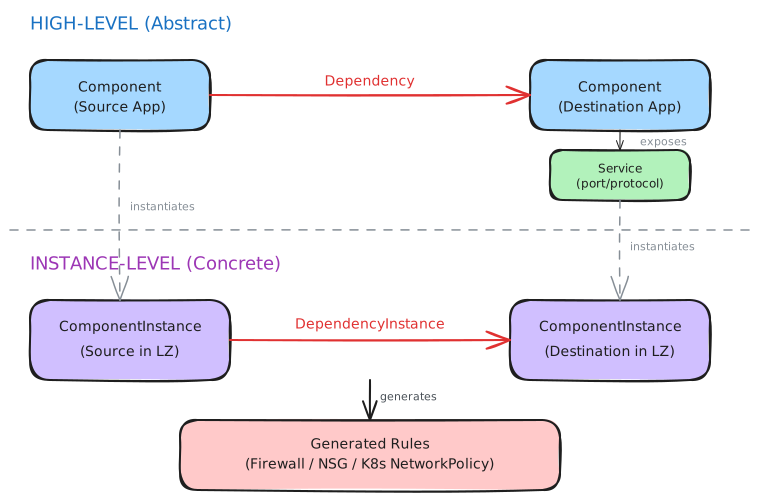
Excalidraw Source
| Layer | Object | Purpose |
|---|---|---|
| High-level | Component | Your application or system (abstract) |
| High-level | Service | A port/protocol exposed by a component |
| High-level | Dependency | A relationship: "Component A needs Component B" |
| Instance | ComponentInstance | A concrete deployment of a component in a specific landing zone |
| Instance | DependencyInstance | A concrete connectivity rule between two component instances |
Component
A Component is the abstract representation of an application, middleware, or system. It is independent of where or how many times it is deployed.
Examples: MyWebApp, MyOracleDB, Splunk, Redis.
Key Attributes
| Attribute | Description |
|---|---|
name | Unique identifier for the component |
is_hosted | Whether this component runs inside a PaaS (container) |
is_hosting | Whether this component hosts other components (e.g., a PaaS platform) |
parents | List of parent components (interface inheritance) |
security_zones | Allowed security zone types (e.g., app, dmz) |
YAML Example
---
api_version: v1
kind: Component
metadata:
  name: MyWebApp
  scope: MyProject
  comment: Web application backend
spec:
  is_hosted: true
  security_zones:
    - app
  parents:
    - SPLUNK_Interface
Service
A Service defines a network endpoint exposed by a component — specifically a port and protocol combination that other components can target.
A component can expose multiple services (e.g., an HTTP API on port 8080 and a metrics endpoint on port 9090).
Key Attributes
| Attribute | Description |
|---|---|
name | Descriptive name for the service |
component | The component that provides this service |
ports | Port number(s) or range (e.g., 8080, 1433) |
protocol | Transport protocol: Tcp, Udp, or Icmp |
is_encrypted | Whether traffic is encrypted |
YAML Example
---
api_version: v1
kind: Service
metadata:
  name: MyWebApp API (tcp/8080)
  scope: MyProject
spec:
  component: MyWebApp
  ports:
    - '8080'
  protocol: Tcp
  is_encrypted: true
---
api_version: v1
kind: Service
metadata:
  name: MyOracleDB listener (tcp/1521)
  scope: MyProject
spec:
  component: MyOracleDB
  ports:
    - '1521'
  protocol: Tcp
  is_encrypted: false
Dependency
A Dependency declares that one component (the source) needs to communicate with another component (the destination). It is a high-level, location-independent statement of intent.
Key Attributes
| Attribute | Description |
|---|---|
name | Descriptive name (e.g., MyWebApp to MyOracleDB) |
source_component | The component that initiates the connection |
target_component | The component that receives the connection |
security_justification | Reason for this connectivity (for governance) |
YAML Example
---
api_version: v1
kind: Dependency
metadata:
  name: MyWebApp to MyOracleDB
  scope: MyProject
spec:
  source_component: MyWebApp
  target_component: MyOracleDB
  security_justification: Backend needs database access for user data
ComponentInstance
A ComponentInstance is the concrete deployment of a component in a specific landing zone. This is where the application model meets the infrastructure model — a component instance has a physical location (landing zone, subnet, zone).
There are two main types:
PaaS-hosted (Container)
A container running in a Kubernetes-based PaaS platform. Its network location is derived from the hosting PaaS's zone instances.
| Attribute | Description |
|---|---|
name | Instance identifier |
component | The parent component |
landingzone | The landing zone where the PaaS resides |
application_phase | Lifecycle phase (e.g., TST, PRD) |
zone_type | Security zone (e.g., app) |
namespace | Kubernetes namespace |
in_zone_instance | Optional: restricts inbound to a specific zone instance |
out_zone_instance | Optional: restricts outbound to a specific zone instance |
IaaS-hosted (VM / Bare-metal)
A traditional virtual machine or physical server. Its network location is explicitly specified through subnet instances.
| Attribute | Description |
|---|---|
name | Instance identifier |
component | The parent component |
landingzone | The landing zone where the VM resides |
application_phase | Lifecycle phase (e.g., TST, PRD) |
zone_type | Security zone (e.g., app) |
in_zone_instance | Zone instance for inbound traffic |
out_zone_instance | Zone instance for outbound traffic |
YAML Examples
DependencyInstance
A DependencyInstance is the concrete connectivity rule between two specific component instances, referencing a specific service. This is the object that ultimately generates firewall rules, NSG rules, and Kubernetes network policies.
Key Attributes
| Attribute | Description |
|---|---|
name | Descriptive name |
landingzone | Landing zone context for this dependency instance |
dependency | Reference to the parent Dependency |
source_component_instance | The source component instance |
target_component_instance | The target component instance |
target_services | List of services to open (port/protocol) |
YAML Example
---
api_version: v1
kind: DependencyInstance
metadata:
name: MyWebApp TST to MyOracleDB TST
scope: MyProject
landingzone: test-west-europe-integration-01
spec:
dependency: MyWebApp to MyOracleDB
source_component_instance: MyWebApp in TST
target_component_instance: MyOracleDB in TST
target_services:
- "MyOracleDB listener (tcp/1521)"
End-to-End Example
Let's walk through a complete scenario with two use cases:
- A PaaS web application connecting to an IaaS database
- Two PaaS applications communicating with each other
All resources are in landing zone test-west-europe-integration-01 (Target: test-west-europe).
Scenario Setup
# =============================================================
# HIGH-LEVEL: Components, Services, Dependencies
# =============================================================
# --- Components ---
---
api_version: v1
kind: Component
metadata:
name: MyWebApp
scope: MyProject
comment: REST API backend (PaaS container)
spec:
is_hosted: true
security_zones:
- app
---
api_version: v1
kind: Component
metadata:
name: MyOracleDB
scope: MyProject
comment: Oracle database (IaaS VM)
spec:
is_hosted: false
security_zones:
- app
---
api_version: v1
kind: Component
metadata:
name: MyFrontend
scope: MyProject
comment: Frontend BFF service (PaaS container)
spec:
is_hosted: true
security_zones:
- app
# --- Services ---
---
api_version: v1
kind: Service
metadata:
name: MyWebApp API (tcp/8080)
scope: MyProject
spec:
component: MyWebApp
ports:
- '8080'
protocol: Tcp
is_encrypted: true
---
api_version: v1
kind: Service
metadata:
name: MyOracleDB listener (tcp/1521)
scope: MyProject
spec:
component: MyOracleDB
ports:
- '1521'
protocol: Tcp
# --- Dependencies ---
---
api_version: v1
kind: Dependency
metadata:
name: MyWebApp to MyOracleDB
scope: MyProject
spec:
source_component: MyWebApp
target_component: MyOracleDB
security_justification: Backend needs DB access
---
api_version: v1
kind: Dependency
metadata:
name: MyFrontend to MyWebApp
scope: MyProject
spec:
source_component: MyFrontend
target_component: MyWebApp
security_justification: Frontend BFF calls backend API
Instance-Level Deployment
# =============================================================
# INSTANCE-LEVEL: ComponentInstances, DependencyInstances
# =============================================================
# --- Component Instances ---
---
api_version: v1
kind: ComponentInstance
metadata:
  name: MyWebApp in TST
  scope: MyProject
  landingzone: test-west-europe-integration-01
spec:
  component: MyWebApp
  application_phase: TST
  zone_type: app
  namespace: myproject-ns
---
api_version: v1
kind: ComponentInstance
metadata:
  name: MyOracleDB in TST
  scope: MyProject
  landingzone: test-west-europe-integration-01
spec:
  component: MyOracleDB
  application_phase: TST
  zone_type: app
  in_zone_instance: app1-db
  out_zone_instance: app1-db
---
api_version: v1
kind: ComponentInstance
metadata:
name: MyFrontend in TST
scope: MyProject
landingzone: test-west-europe-integration-01
spec:
component: MyFrontend
application_phase: TST
zone_type: app
namespace: myproject-ns
# --- Dependency Instances ---
---
api_version: v1
kind: DependencyInstance
metadata:
  name: MyWebApp TST to MyOracleDB TST
  scope: MyProject
  landingzone: test-west-europe-integration-01
spec:
  dependency: MyWebApp to MyOracleDB
  source_component_instance: MyWebApp in TST
  target_component_instance: MyOracleDB in TST
  target_services:
    - "MyOracleDB listener (tcp/1521)"
---
api_version: v1
kind: DependencyInstance
metadata:
name: MyFrontend TST to MyWebApp TST
scope: MyProject
landingzone: test-west-europe-integration-01
spec:
dependency: MyFrontend to MyWebApp
source_component_instance: MyFrontend in TST
target_component_instance: MyWebApp in TST
target_services:
- "MyWebApp API (tcp/8080)"
Generated Security Rules
From the dependency instances defined above, Yggy generates security rules that are deployed to three enforcement layers. Below are illustrative examples of what gets generated.
Firewall Rules
Firewall rules control traffic between zones at the perimeter level. They are generated as connectivity rules and pushed to Azure Firewall or PaloAlto via automation.
For MyWebApp TST → MyOracleDB TST (PaaS to IaaS, TCP/1521):
{
  "name": "ar-from-mywebapp_in_tst-to-myoracledb_in_tst-tcp_1521",
  "dependencyInstanceName": "MyWebApp TST to MyOracleDB TST",
  "scope": "MyProject",
  "protocol": "Tcp",
  "ports": ["1521"],
  "srcObjectGroup": {
    "name": "ag-mywebapp_in_tst",
    "type": "AddressGroup",
    "zoneType": "app",
    "endpoints": [
      { "type": "cidr", "value": "172.16.0.0/24", "description": "app1-paas-out" }
    ]
  },
  "dstObjectGroup": {
    "name": "ag-myoracledb_in_tst",
    "type": "AddressGroup",
    "zoneType": "app",
    "endpoints": [
      { "type": "cidr", "value": "172.16.1.0/27", "description": "app1-db" }
    ]
  }
}
NSG Rules (Network Security Group)
NSG rules filter traffic at the subnet level within a landing zone. They are generated per subnet and direction.
Yggy produces a JSON payload consumed by the NSG automation to apply rules on the target subnet's NSG:
{
  "landingZone": "test-west-europe-integration-01",
  "subnetInstance": "app1-db",
  "rules": [
    {
      "name": "nsg-allow-mywebapp_tst-to-myoracledb_tst-tcp_1521-inbound",
      "priority": 1200,
      "direction": "Inbound",
      "access": "Allow",
      "protocol": "Tcp",
      "sourceAddressPrefix": "172.16.0.0/24",
      "destinationAddressPrefix": "172.16.1.0/27",
      "destinationPortRange": "1521",
      "dependencyInstanceName": "MyWebApp TST to MyOracleDB TST",
      "scope": "MyProject"
    }
  ]
}
And the corresponding outbound rule on the source subnet's NSG:
{
  "landingZone": "test-west-europe-integration-01",
  "subnetInstance": "app1-paas-out",
  "rules": [
    {
      "name": "nsg-allow-mywebapp_tst-to-myoracledb_tst-tcp_1521-outbound",
      "priority": 1200,
      "direction": "Outbound",
      "access": "Allow",
      "protocol": "Tcp",
      "sourceAddressPrefix": "172.16.0.0/24",
      "destinationAddressPrefix": "172.16.1.0/27",
      "destinationPortRange": "1521",
      "dependencyInstanceName": "MyWebApp TST to MyOracleDB TST",
      "scope": "MyProject"
    }
  ]
}
This results in the following NSG rules being applied:
For the destination subnet app1-db (inbound):
Priority  Direction  Source CIDR      Dest CIDR       Port  Protocol  Action
1200      Inbound    172.16.0.0/24    172.16.1.0/27   1521  Tcp       Allow
For the source subnet app1-paas-out (outbound):
Priority  Direction  Source CIDR      Dest CIDR       Port  Protocol  Action
1200      Outbound   172.16.0.0/24    172.16.1.0/27   1521  Tcp       Allow
Kubernetes Network Policies
For traffic between two PaaS containers in the same cluster (MyFrontend → MyWebApp on port 8080), Yggy produces a JSON payload consumed by the Kubernetes operator to generate NetworkPolicies:
{
  "landingZone": "test-west-europe-integration-01",
  "namespace": "myproject-ns",
  "policies": [
    {
      "name": "allow-myfrontend-to-mywebapp",
      "dependencyInstanceName": "MyFrontend TST to MyWebApp TST",
      "scope": "MyProject",
      "direction": "Ingress",
      "targetPodSelector": {
        "matchLabels": { "app": "mywebapp" }
      },
      "peers": [
        {
          "namespaceSelector": { "matchLabels": { "name": "myproject-ns" } },
          "podSelector": { "matchLabels": { "app": "myfrontend" } }
        }
      ],
      "ports": [
        { "protocol": "TCP", "port": 8080 }
      ]
    }
  ]
}
The operator reconciles this into the following Kubernetes NetworkPolicy:
apiVersion: networking.k8s.io/v1
kind: NetworkPolicy
metadata:
  name: allow-myfrontend-to-mywebapp
  namespace: myproject-ns
spec:
  podSelector:
    matchLabels:
      app: mywebapp
  policyTypes:
    - Ingress
  ingress:
    - from:
        - namespaceSelector:
            matchLabels:
              name: myproject-ns
          podSelector:
            matchLabels:
              app: myfrontend
      ports:
        - protocol: TCP
          port: 8080
Enforcement Layers
The three rule types are not mutually exclusive. A connection from a PaaS container to an IaaS VM will generate:
- A Kubernetes egress policy on the source pod
- An NSG outbound rule on the PaaS subnet
- A Firewall rule if zones cross a firewall boundary
- An NSG inbound rule on the destination subnet
Yggy determines which layers apply based on the source and destination locations in the infrastructure model.
Summary
| Step | What You Define | What Gets Generated |
|---|---|---|
| 1. Component | Your application identity | — |
| 2. Service | Ports & protocol you expose | — |
| 3. Dependency | Who talks to whom (abstract) | — |
| 4. ComponentInstance | Where your app is deployed | — |
| 5. DependencyInstance | Concrete connectivity link | Firewall rules, NSG rules, K8s NetworkPolicies |
The application model separates intent (what you need) from enforcement (how it's implemented), letting teams declare their connectivity requirements without needing to understand the underlying network security mechanisms.