Core Concepts
This document covers the foundational concepts behind Yggy — the building blocks that make declarative, infrastructure-independent connectivity management possible.
Tip
If you haven't read Why Yggy? yet, start there for the problem context and motivation.
Descriptors
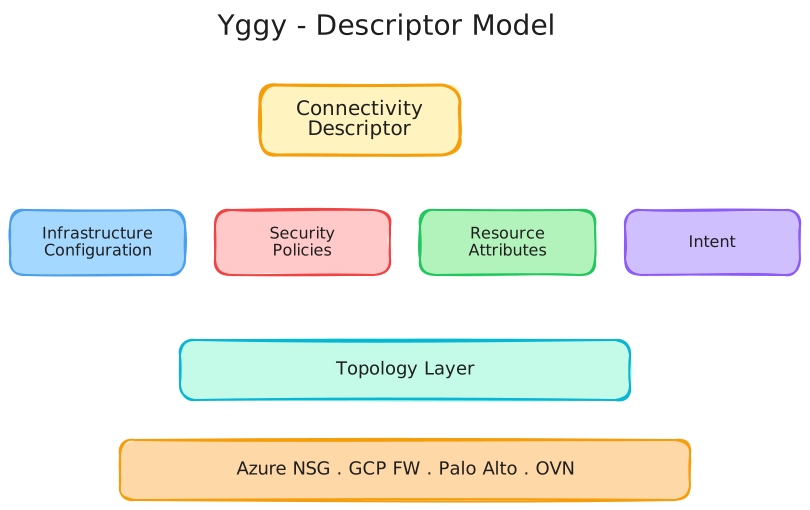
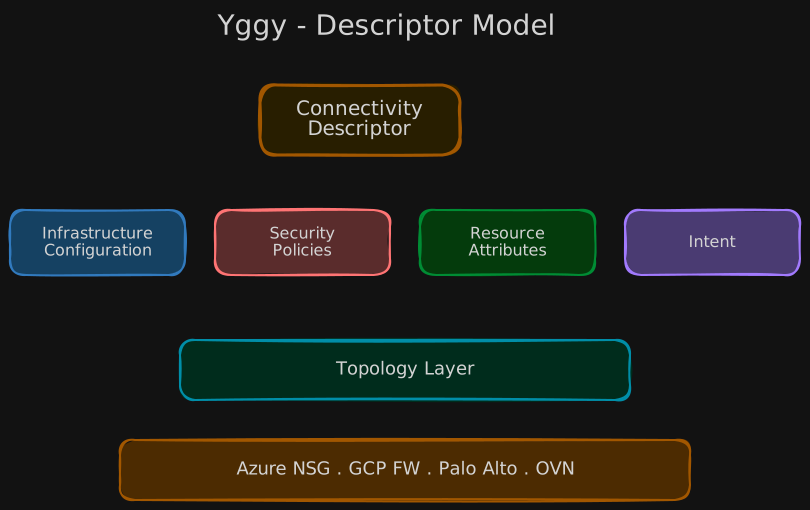
A descriptor is an abstract representation of a network resource, configuration, policy, or connectivity intent. Descriptors are the fundamental unit of Yggy's model. They capture what connectivity should look like without prescribing how it is implemented on any specific platform.
Using a Kubernetes-like declarative syntax, descriptors represent infrastructure and then link it with application requirements and connectivity intent.
Excalidraw Source
Descriptors include information across four categories:
Infrastructure Configuration
Describes the physical and logical network topology:
- IP address ranges and subnets
- VLANs and network segments
- Routing policies and tables
- Virtual networks and their relationships
Security Policies
Captures security requirements and guardrails:
- Connectivity guardrails and boundaries
- Access control configurations (NSGs, firewall rules)
- VPN settings and encryption requirements
- Security zone definitions
Resource Attributes
Defines the compute, storage, and network resources:
- Compute instances and their network interfaces
- Storage volumes and access paths
- Network interfaces and bindings
- Service endpoints
Intent
Expresses desired outcomes rather than specific configurations:
- Performance targets (throughput, latency)
- Availability requirements (redundancy, failover)
- Response time objectives
- Quality of service parameters
Topology
Yggy maintains a model of the underlying network and system topology — the actual infrastructure landscape across all environments. Descriptors are mapped onto this topology to form the unified abstract model.
The topology captures:
- Sites and locations — data centers, cloud regions, edge locations
- Network segments — VNets, VPCs, subnets, VLANs
- Interconnections — WAN links, VPN tunnels, peerings, Direct Connect
- Security boundaries — landing zones, security zones, implementation zones
By combining descriptors with topology, Yggy can reason about connectivity end-to-end, across platforms and providers.
Intent
Yggy distinguishes between two types of intent:
Application Intent
What applications need from the network:
- "Service A must reach Service B with less than 10ms latency"
- "This workload requires encrypted connectivity to the database tier"
- "These microservices need mutual connectivity within their namespace"
Application intent is processed by the App Intent Service, which generates the App Intent Graph — a graph structure capturing service-to-service connectivity requirements.
Infrastructure Intent
What the infrastructure team wants to enforce:
- "All traffic between zones must traverse the firewall"
- "Production and test workloads must be segregated"
- "Egress traffic must go through the network service edge"
Infrastructure intent is processed by the Infra Intent Service, which generates the Infra Intent Graph — a graph structure capturing topology constraints, security boundaries, and routing policies.
The Intent Graph
The Intent Graph combines both application and infrastructure intent into a unified graph. During the transformation pipeline, this graph is used to:
- Validate that application requirements don't violate infrastructure policies
- Compute the optimal connectivity paths across the topology
- Generate platform-specific configurations that satisfy both types of intent
Declarative Connectivity
Traditional network management follows a cycle: plan → implement → document. Documentation lags behind reality, and drift accumulates over time.
Yggy flips this paradigm:
The Yggy Philosophy
The descriptor IS the documentation. The documentation IS the action.
Instead of configuring infrastructure and then documenting what was done, you declare your connectivity intent in a descriptor. Yggy's transformation pipeline reads these declarations and produces platform-specific configurations that are deployed to the target infrastructure.
This approach provides:
- Single source of truth — The descriptor is always up to date because it is the configuration.
- Auditability — Every change is versioned and traceable through the system.
- Consistency — The same descriptor produces consistent results across environments.
- Testability — Descriptors can be validated before deployment.
- Distributed control — Different teams manage their own descriptors, while governance is centralized.
Versioning
Every change in Yggy produces a new version of the affected descriptors. Versions follow a strict lifecycle:
- Created — A new version is initialized with the proposed changes
- Sealed — The version is finalized and becomes immutable
- Published — The sealed version is deployed to target infrastructure
Sealed versions form the audit trail and enable rollback to any previous state. This guarantees full traceability of every connectivity change across the entire infrastructure.
Infrastructure Types Managed
The provider model targets a growing set of infrastructure platforms:
| Provider | Resources Managed | In this release |
|---|---|---|
| Azure | Virtual Networks (VNets), Subnets, Network Security Groups (NSGs), Hub/Spoke topologies | Yes — network security groups |
| Google Cloud | Virtual Private Clouds (VPCs), Firewall rules | No |
| Palo Alto | Firewall configurations, security policies | No |
| OpenShift | OVN (Open Virtual Network) Network Policies | No |
One provider integration ships today
This release publishes the Azure network security group integration (aud/libraries/lib-azure-nsg). The other rows describe where the provider model is going; there is no code for them in this repository. See the scope note on Architecture.
The modular architecture allows new providers to be added without modifying the core system. See Architecture for details on the provider model.
Further Reading
- Why Yggy? — The problem and the approach
- Architecture — How the system is built
- Change Flow — How changes move through the pipeline
- Wiki Home — Back to the wiki