Architecture
This document describes the Yggy system architecture — its layered design, service components, storage model, and integration points.
Target architecture, not the shipped scope
This page describes the architecture Yggy is built towards. This release publishes the v1 codebase in aud/: the model and data libraries, one provider integration (Azure network security groups), and two Quarkus services — the HTTP API and the connectivity engine. Other components described below are internal, in development, or planned.
Prerequisites
Read Core Concepts first to understand descriptors, intent, and topology.
High-Level Overview
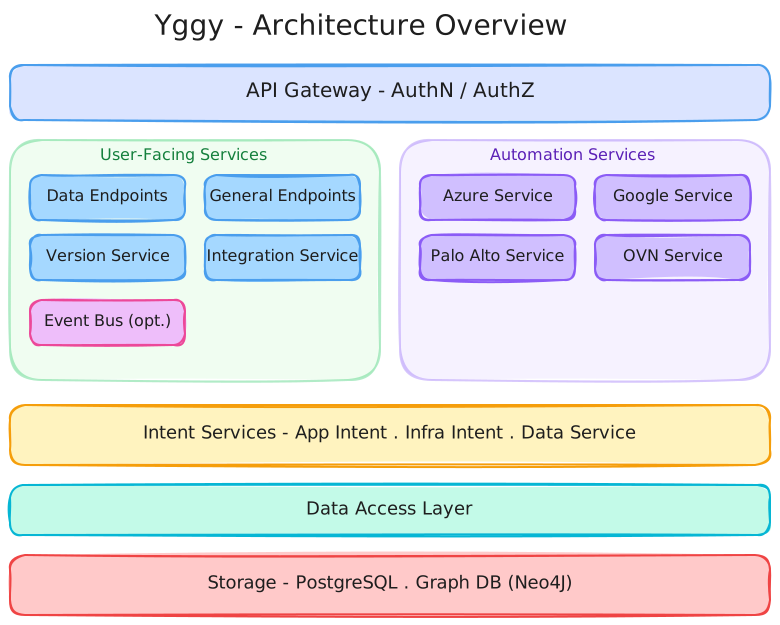
Yggy follows a microservice architecture built with Quarkus, organized in layers:
Excalidraw Source
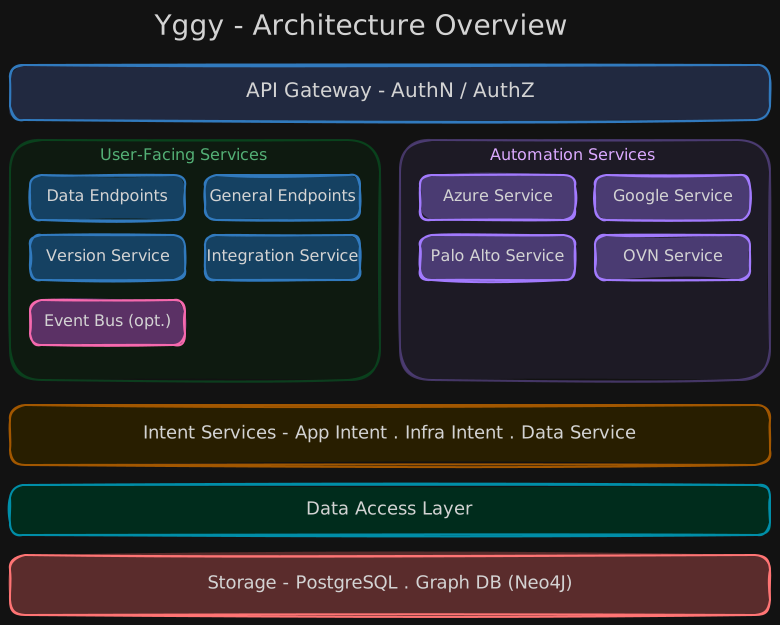
The system is structured in five primary layers:
- API Gateway — Authentication, authorization, and routing
- Service Layer — User-facing and automation microservices
- Intent Layer — App and infra intent processing with graph computation
- Data Access Layer — Abstraction over storage queries
- Storage Layer — PostgreSQL for data, graph database for topology and intent
API Gateway & AuthN/AuthZ
All requests enter through the API Gateway, which handles:
- Authentication — Verifying the identity of callers
- Authorization — Enforcing role-based access control
- Routing — Directing requests to the appropriate micro-service
The gateway provides a single entry point for all consumers: SRE teams, automation pipelines, CLI tools, and third-party integrations.
User-Facing Services
These services expose the core API for human and programmatic consumers:
Data Endpoints
Provides CRUD operations for descriptors, infrastructure objects, and connectivity data. This is the primary interface for reading and writing Yggy's data model.
General Endpoints
Exposes utility and administrative operations — health checks, metadata, and system information.
Version Service
Manages the versioning lifecycle of descriptors:
- Creating new versions
- Sealing (finalizing) versions
- Querying version history
- Rollback support
Every change in Yggy produces a new version, providing full auditability and the ability to roll back to any previous state.
Integration Service
Orchestrates the change flow — receiving changes, validating them, running the transformation pipeline, and coordinating deployment. See Change Flow for the full process.
Automation Services
These services translate Yggy's abstract model into platform-specific configurations:
Provider Services
| Service | Responsibility |
|---|---|
| Azure Service | Generates Azure VNet, Subnet, NSG, and Hub/Spoke configurations |
| Google Service | Generates Google Cloud VPC and Firewall rule configurations |
| Palo Alto Service | Generates Palo Alto firewall security policies |
| OVN Service | Generates OpenShift OVN Network Policies |
Each provider service is a pluggable module. New providers can be added without modifying the core system — just implement the provider interface and register it.
Intent Services
App Intent Service
Processes application-level connectivity intent — what applications need from the network. Generates the App Intent Graph that captures service-to-service connectivity requirements.
Infra Intent Service
Processes infrastructure-level connectivity intent — what the network team wants to enforce. Generates the Infra Intent Graph that captures topology constraints, security boundaries, and routing policies.
The intent graphs are combined during the transformation pipeline to produce the final connectivity configuration.
Data Access Layer
The Data Access Layer (DAL) provides an abstraction over SQL queries, decoupling the service layer from the storage implementation. This design choice means:
- Changing storage technology has minimal impact on services
- Query optimization is centralized
- Data access patterns are consistent across services
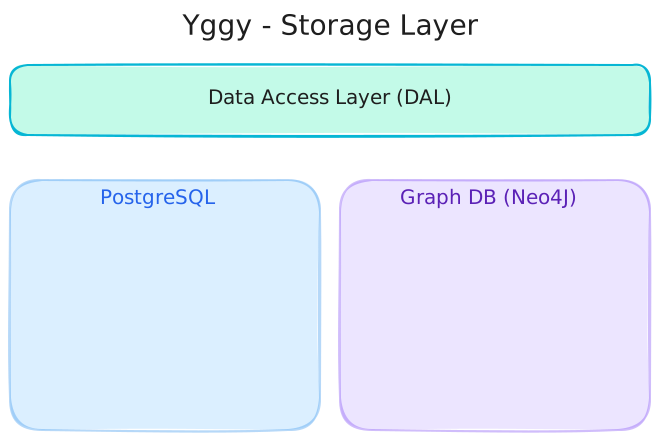
Storage Layer
Excalidraw Source
PostgreSQL
The primary data store for Yggy's data model:
- Descriptor definitions and versions
- Infrastructure configuration data
- Security policies and governance rules
- Deployment tracking and operation history
Graph Database
Under Discussion
Neo4J is the leading candidate for the graph database.
A graph database stores the intent and topology graphs:
- Connectivity relationships between resources
- Network topology and path analysis
- Intent graph for application and infrastructure connectivity
- Enables efficient graph traversal queries for connectivity validation
Event Bus (Optional)
An optional event bus enables asynchronous communication between services:
- Decouples services for better scalability
- Enables event-driven automation workflows
- Supports notification and webhook patterns
Integration Points
Yggy is designed to integrate with the broader infrastructure automation ecosystem:
| Tool | Integration |
|---|---|
| Kratix | Platform-as-a-Service orchestration |
| Humanitec | Internal Developer Platform integration |
| Backstage | Developer portal and service catalog |
| Terraform | Infrastructure-as-Code deployment |
| Jenkins | CI/CD pipeline integration |
| Bitbucket | Source control and PR-based workflows |
| Kubernetes Operator | Kubernetes-native deployment and reconciliation |
| Yggy CLI | Command-line interface for direct interaction |
| Yggy Viewer | Web-based visualization of connectivity and topology |
Further Reading
- Why Yggy? — The problem Yggy solves
- Core Concepts — Descriptors, intent, and declarative connectivity
- Change Flow — How changes move through the pipeline
- Wiki Home — Back to the wiki